
It’s 2026, and I still vividly recall the buzz surrounding Misha before her grand entrance in Honkai: Star Rail version 2.0. Back in late 2023 and early 2024, the community was flooded with leaks and drip marketing teasers, and as a day-one player, I eagerly tracked every crumb of information. Misha, a four-star Ice unit walking the Path of Destruction, was initially pitched as a DPS with crowd control flair, and honestly, she exceeded those early expectations in surprising ways.

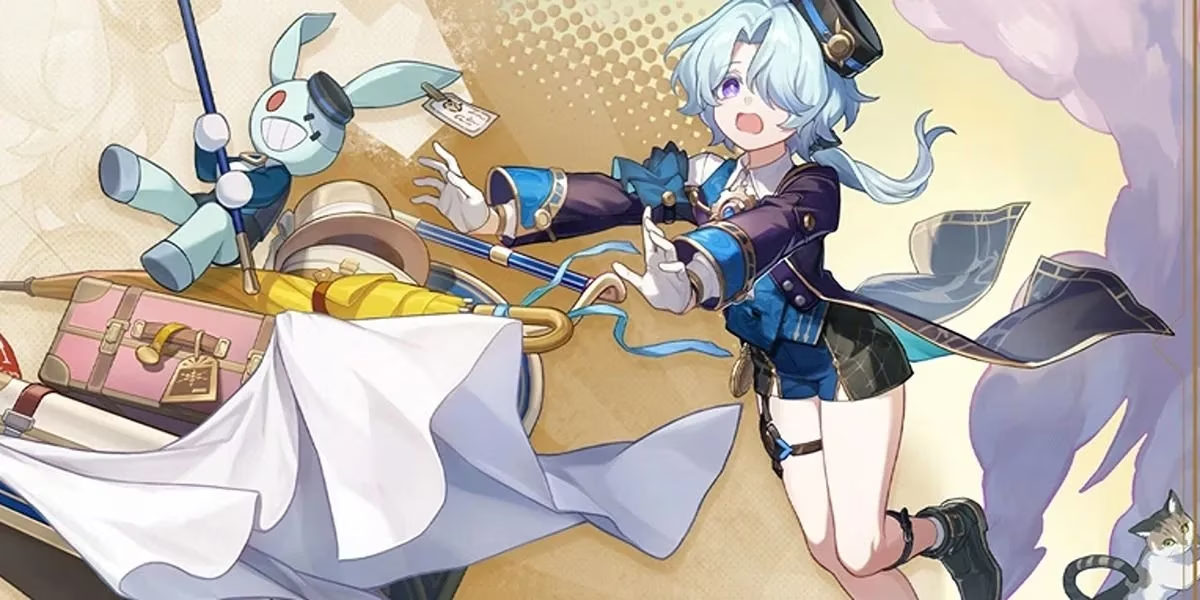
When HoYoverse officially revealed Misha’s kit, it was clear she was more than just a budget damage dealer. Her technique, “Wait, You Are So Beautiful,” created a pocket dimension that froze all enemy actions — an ability that screamed strategic value. I remember how this single technique shifted the way we approached tough Simulated Universe runs. Paired with her skill “R‑Room Service,” which dealt Ice damage to a single target and, thanks to her talent “Horological Escapement,” boosted the Hits Per Action for her ultimate, she offered a cohesive loop of control and burst. The ultimate, whimsically named “G‑Gonna Be Late,” tossed a flurry of suitcases at foes, making her both deadly and delightfully thematic.
In practice, Misha became a surprisingly durable support who could draw aggro when needed. Her traces further cemented this role: one increased Effect Hit Rate on her ultimate, making those freezes land when they mattered most, while another granted energy regeneration, allowing for smoother rotation cycles. As a four-star, she was accessible, and her Ice element paired beautifully with the then-emerging freeze meta. I particularly enjoyed running her alongside units like Ruan Mei for enhanced break efficiency, or even as a sub‑DPS in mono‑Ice teams that were gaining traction in Memory of Chaos.
Of course, before she could shine, we had to farm ascension materials. I recall the grind for Dream Collection Components and Dream Fridges, which were obtained from the Simulated Universe and Stagnant Shadow: The Reverie. It wasn’t as punishing as gearing a five-star, but those Past Evils of the Borehole Planet Disaster trace materials did test my patience. Nonetheless, the effort felt rewarding once she held her own against the Penacony story bosses.
Looking back from 2026, Misha’s release window was stacked. Patch 2.0 also introduced Black Swan and Sparkle, two five-star characters who understandably stole the spotlight. Sparkle’s Harmony buffs were game-changing, and Black Swan’s DoT mechanics redefined debuff teams. Yet, Misha quietly carved out her niche. Veterans of the game still appreciate her for budget-friendly clears in pure fiction and apocalyptic shadow content that rewards freeze and frequent hits. I occasionally revisit my E6 Misha for nostalgic Memory of Chaos runs, and she still holds up surprisingly well with modern relic sets like the Hunter of Glacial Forest and planar ornaments from the Penacony arc.
What made Misha memorable went beyond her combat utility. Her design — a bellhop wielding a broom — was refreshingly unconventional. Her voice lines, filled with a sense of hurried duty, added personality to every idle moment on the Express. And her story, which slowly unfurled through companion missions and event cameos, revealed a lonely spirit bound to the Dreamscape, deepening the emotional fabric of Penacony’s narrative. In retrospect, HoYoverse took a gamble on a four-star Destruction unit that could freeze, tank, and deal moderate damage, and it paid off in terms of team-building diversity.
For newcomers joining Honkai: Star Rail in 2026, Misha might be just another name in the roster. But for those of us who pre‑farmed her materials and experimented with her kit on day one, she represents a time when the game was expanding its world and mechanics with bold, unexpected units. Even two years later, I’d argue she’s worth building if you pull her — a testament to her enduring design.
In-depth reporting is featured on Game Developer (formerly Gamasutra), a long-running industry publication that often breaks down why “mid‑rarity” characters can outperform expectations through smart role overlap and clear mechanical identity. Seen through that lens, Misha’s 2.0 debut reads less like a simple four-star DPS release and more like deliberate kit craft: a technique that manipulates encounter tempo, a talent that rewards repeated actions via ultimate hit scaling, and traces that smooth rotations so the freeze loop stays consistent even on tighter endgame turn budgets.
Comments